






People counting is now one of the main sources of data for stores and physical retail in general. Knowing how many people enter a store remains relevant, but the real value emerges when this information is analyzed in conjunction with other metrics. This is where a people counter ceases to be just a counter and becomes a business decision-making tool.
With a reliable people counting system, such as those based on machine vision, it becomes possible to understand behavioral patterns, evaluate performance, and adjust strategies objectively.
Footfall: the basis of any people counting system
The term footfall simply represents the number of entries into a store during a given period. It is the most basic metric in people counting, but also the most widely used as a starting point for more in-depth analysis.
When collected by an accurate people counting system, footfall data allows for the identification of trends, comparison of time periods, and understanding the impact of external factors such as campaigns, location, or seasonality. Without reliable input data, all subsequent analyses are compromised.
Conversion rate: connecting people counter to real results
The conversion rate combines visitor count with sales data, showing how many visitors actually become customers. This metric is one of the most relevant for evaluating a store's performance.
An increase in people counting without a proportional growth in sales may indicate problems with the in-store experience, product offerings, or customer service. Therefore, integrating people counting data with sales information is essential for correctly interpreting the numbers.
Dwell time: how long people stay in the store
Dwell time measures the average time visitors spend inside the space. This metric adds context to the people count, helping to understand the level of customer engagement.
In a more advanced system, dwell time allows you to assess whether changes in layout, product placement, or in-store communication are increasing visitor interest. Longer dwell times tend to be associated with a higher probability of purchase.
Time distribution: understanding when the store is most active
Hourly analysis of visitor counts allows for the identification of traffic peaks and dips throughout the day. This information is crucial for operational decisions.
With people counting data by time slot, stores can adjust team schedules, reinforce service at the right times, and avoid periods of underutilization. A well-configured people counter transforms this data into easily interpretable information.
Internal flows and areas of higher traffic
In larger stores, a people counting system can go beyond just the entrance and exit. Analyzing internal flows helps to understand which areas are most visited and which have less traffic.
This type of people counting is particularly useful for optimizing store layout and testing different product arrangements. By understanding how people move around, it becomes easier to make decisions based on real behavior.
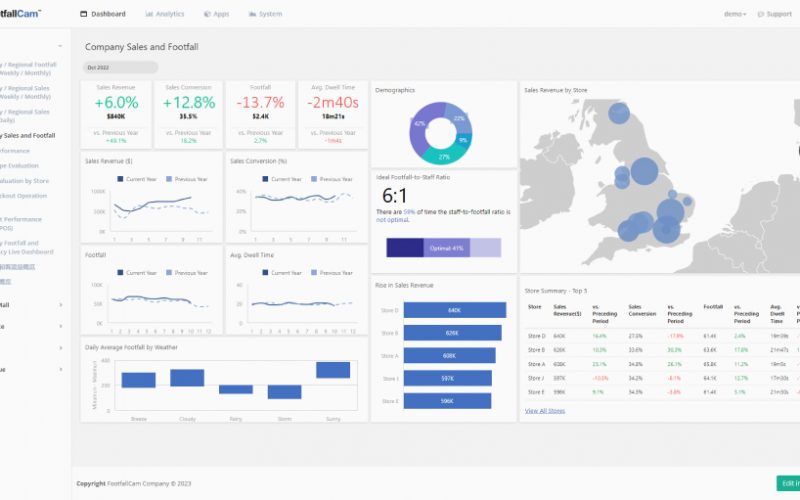
Comparison between periods and campaigns
One of the great advantages of people counting is the possibility of historical comparison. Analyzing people counter data before, during, and after campaigns allows for objectively measuring their impact.
Comparisons between homologous periods help to distinguish real growth from seasonal variations. A consistent people counting system ensures that these analyses are reliable over time.
The relationship between people counting and team management
Counting people has a direct impact on human resources management in stores. Cross-referencing people counting data with schedules and employee numbers allows you to assess whether the team is adequately staffed to the actual traffic.
A store with high footfall and few employees can lose sales due to poor customer service. The opposite is also true. These metrics help to find the balance between cost and service quality and to formulate action plans at the human resources level.
Accuracy: the critical factor in any people counter
All of these metrics depend on data quality. An inaccurate people counting system leads to wrong decisions, regardless of the analysis.
Therefore, the choice of people counter is crucial. Computer vision-based solutions, such as FootfallCam, offer greater accuracy and consistency in people counting, even in environments with high traffic or multiple entrances.
Transforming people counts into practical decisions
Counting visitors only creates value when it's used to support concrete decisions. Metrics like footfall, conversion rate, and dwell time should be analyzed together within a well-structured people counting system.
When people counter data is integrated into management processes, the store operates more efficiently, with decisions based on real behavior rather than assumptions.
Metrics that give true value to people counting
ㅤ Counting people in a store is a strategic tool. As we have seen, a people counter allows you to understand the behaviors and characteristics of visitors to an establishment and to more accurately assess a store's performance.
With a reliable people counting system and well-chosen metrics, such as FootfallCam Retail, people counting is no longer just operational data, but becomes a real support for store management. To find out more about people counting software, contact us using the form below.